
The Science Chamber (BEC III)


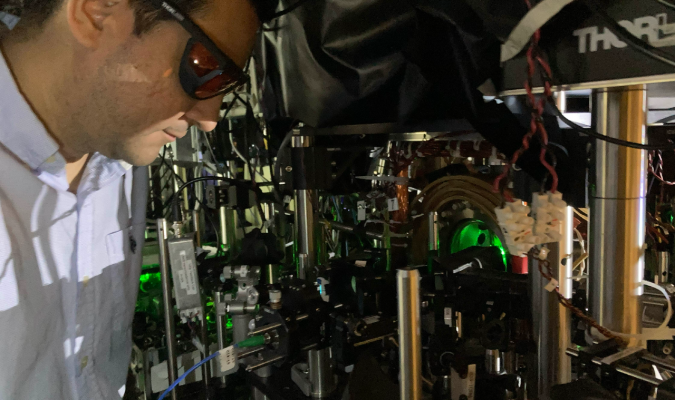
The Science Chamber (2003): (Clockwise from top left) Andre Schirotzek (currently with Lithium experiment), Michele Saba, Dave Pritchard, Wolfgang Ketterle, Yong-Il Shin, Tom Pasquini, and Aaron Leanhardt (now at NIST Boulder). Gyu-Boong Jo not pictured.


Experimental Work in BEC III

The BEC III apparatus is a third generation machine, intended to allow for easy manipulation of sodium Bose Einstein condensates (BEC). BEC is moved with optical tweezers from the production chamber into the auxiliary "science chamber". Once in the science chamber, condensates are loaded into magnetic and optical microtraps for study. The science chamber affords us flexibility in experimental design and rapid cycling of experiments without compromising the vaccuum required for condensate production. Here is a description of the apparatus (parts of Ananth Chikkatur's Thesis) (pdf, 1.7 MB)

Research in BEC III is focused on the manipulation of condensates and novel trapping geometries. Below is a bit about the most recent research that we've been doing. Older projects and theses from previous group members can be found here.


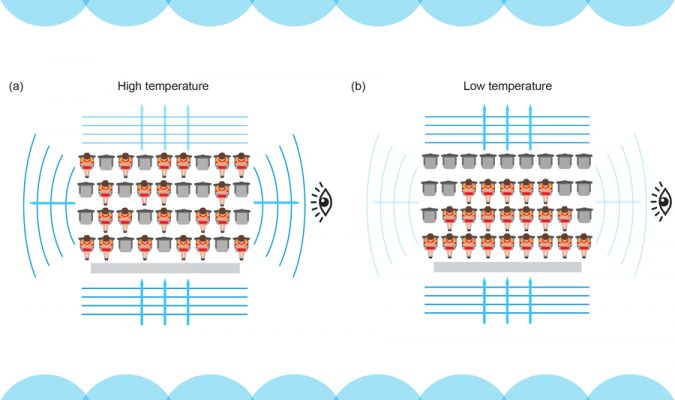
Continuous Phase Measurement by Light Scattering

We demonstrate an experimental technique to measure continuously and non-destructively the relative phase between two spatially separated Bose-Einstein condensates. This phase measurement can be used to create a phase if the condensates were not in state with well-defined relative phase, to read out the phase, and to monitor the phase evolution. We applied the technique to realize a sensitive atom interferometer with trapped Bose-Einstein condensates.

Cartoon schematic of the optical readout of the relative phase of two condensates.


Decay of Doubly Quantized Vortices

Doubly quantized vortices were topologically imprinted in |F = 1> Na condensates, and their time evolution was observed using a tomographic imaging technique. The decay into two singly quantized vortices was characterized and attributed to dynamical instability. The time scale of the splitting process was found to be longer at higher atom density.

A doubly charged vortex is created topologically by inverting the bias field. The unstable doubly charged vortex will decay into two singly charged vortices.


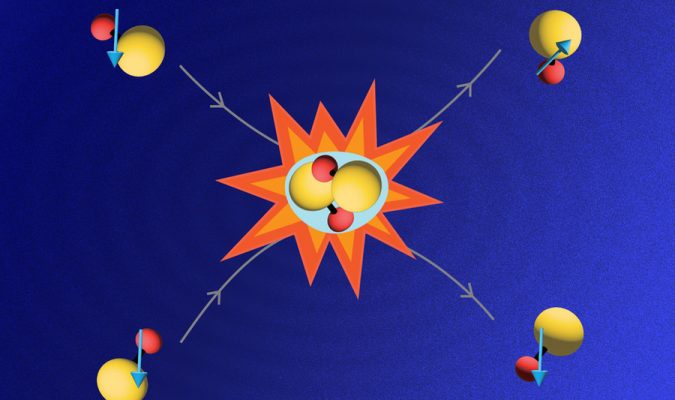
Quantum Reflection

We observed quantum reflection of ultracold atoms from the attractive potential of a solid surface. Extremely dilute Bose-Einstein condensates of Na, with peak density 10^(11)-10^(12) atoms/cm^3, confined in a weak gravitomagnetic trap were normally incident on a silicon surface. Reflection probabilities of up to 20% were observed for incident velocities of 1-8 mm/s. The velocity dependence agrees qualitatively with the prediction for quantum reflection from the attractive Casimir-Polder potential. Atoms confined in a harmonic trap divided in half by a solid surface exhibited extended lifetime due to quantum reflection from the surface, implying a reflection probability above 50%.

Cartoon schematic for quantum reflection. The signature of quantum reflection is the interruption of the dipole oscillation of the condensate.


BEC Distillation in a Double-Well Potential

Bose-Einstein condensates of sodium atoms, prepared in an optical dipole trap, were distilled into a second empty dipole trap adjacent to the first one. The distillation was driven by thermal atoms spilling over the potential barrier separating the two wells and then forming a new condensate. This process serves as a model system for metastability in condensates, provides a test for quantum kinetic theories of condensate formation, and also represents a novel technique for creating or replenishing condensates in new locations.

Cartoon schematic of the condensate distillation process. A Bose-Einstein Condensate located in the original well (top) distills over several seconds into a new ground state.


Latest News: Congratulations to Christian Sanner, who successfully defended his Masters thesis.