News: Research Highlights
Thu February 22, 2018

Triatomic Molecules

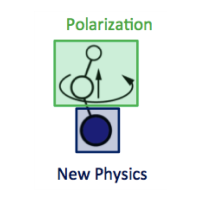
In the simplest molecues, diatomic molecules made form two atoms, the vibration and rotation degrees of freedom gives rise to new features such as strong long-range dipolar interactions between molecules, a key ingredient in many quantum simulation and quantum computing proposals. Polyatomic molecules are an exciting new research frontier, as these molecules offer an even...
News type:
Tue January 30, 2018

Atomically Thin Mirrors Made from a Monolayer Semiconductor

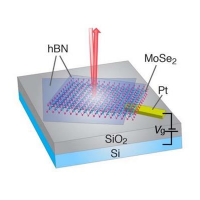
Conventional mirrors have fundamental thickness limitations: the skin depth for metallic mirrors, and the wavelength of light for dielectric mirrors. Recently, the Park Group has demonstrated that these limitations can be overcome with the atomically thin semiconductor molybdenum diselenide [1]. To understand how this can be achieved, one has to consider how light is reflected...
News type:
Thu August 10, 2017

Ultracold molecules hold promise for quantum computing

Researchers have taken an important step toward the long-sought goal of a quantum computer, which in theory should be capable of vastly faster computations than conventional computers, for certain kinds of problems. The new work shows that collections of ultracold molecules can retain the information stored in them, for hundreds of times longer than researchers have previously achieved in these materials.

Wed February 15, 2017

High-res biomolecule imaging

Technique could provide unique views of single molecules that conventional methods can’t match.

News type:
Wed January 1, 2014

Many-body Dynamics of Dipolar Molecules in an Optical Lattice

Understanding the many-body dynamics of isolated quantum systems is one of the central challenges in modern physics. To this end, the direct experimental realization of strongly correlated quantum systems allows one to gain insights into the emergence of complex phenomena. Such insights enable the development of theoretical tools that broaden our understanding. In our study,...
News type:
Wed January 1, 2014

Properties of the ground 3F2 state and the excited 3P0 state of atomic thorium in cold collisions with 3He

We measure inelastic collisional cross sections for collisions between thorium (Th) and helium. We determine for Th 3F2-He the ratio of the momentum-transfer to Zeeman relaxation cross sections for collisions to be g~500 at 800 mK. For Th 3P0-He collisions, we observe no measureable quenching of this metastable state, even after 106 collisions. This allowed...
News type:
Wed January 1, 2014

Time-resolved magnetic sensing with electronic spins in diamond

One of the most promising applications of quantum information is in precision metrology. In the past year we focused on magnetic sensing with NV centers in diamond, in particular focusing on techniques to extend magnetic field sensing at the nano-scale to time-dependent reconstruction of magnetic fields and spectroscopy.
News type:
Wed January 1, 2014

Quantum Interference Between Independent Reservoirs in Open Quantum Systems

When a quantum system interacts with multiple reservoirs, the environmental effects are usually treated in an additive manner. We showed that that assumption breaks down for non-Markovian environments that have finite memory times. Specifically, we demonstrated that quantum interferences between independent environments could qualitatively modify the dynamics of the physical system. We illustrated that effect...
News type: