

Skip to content
← Back to All News

News: Research Highlights

262 articles

Thu, May 9, 2019

Near Unitary Squeezing

A group at the MIT led by Prof. Vladan Vuletić has recently generated significant amount of spin squeezing-a type of quantum entanglement-in an ultracold vapor of ytterbium-171. Spin squeezed states (SSS) can be used to overcome the standard quantum limit (SQL) which bounds state-of-the-art atomic sensors like optical clocks. The latter deploy a dilute vapor...

Read More »

Thu, May 2, 2019

String patterns in the doped Hubbard model

Understanding strongly correlated quantum many-body states is one of the most thought-provoking challenges in modern research. For example, the Hubbard model, describing strongly correlated electrons in solids, still contains fundamental open questions on its phase diagram. In this work we realize the Hubbard Hamiltonian and search for specific patterns within many individual images of realizations...

Read More »

Mon, April 22, 2019

Direct Laser Cooling Rubidium Atoms

A group at MIT led by Vladan Vuletic has recently created a Bose-Einstein Condensate (BEC) of rubidium atoms with a new method, direct laser cooling. Many researchers have attempted this elusive goal in the past, but due to various complications resorted to reaching BEC through evaporation instead. Compared to cooling through evaporation, laser cooling is...

Read More »

Fri, April 19, 2019

Probing entanglement in a many-body-localized system

An interacting quantum system that is subject to disorder may cease to thermalize due to localization of its constituents, thereby marking the breakdown of thermodynamics. The key to our understanding of this phenomenon lies in the system’s entanglement, which is experimentally challenging to measure. We realize such a many-body-localized system in a disordered Bose-Hubbard chain...

Read More »

Wed, March 13, 2019

Quantum sensing method measures minuscule magnetic fields

MIT researchers find a new way to make nanoscale measurements of fields, including information about their direction.

Read More »

Tue, January 29, 2019

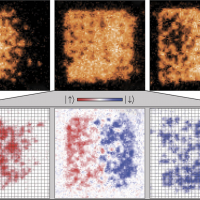
Spin Transport in a Mott Insulator of Ultracold Fermions

Superconductivity is a phenomenon in materials whereby electron pairs can flow freely without resistance. As a consequence, no energy is lost while electrical current passes through the superconductor. The benefits, therefore, of superconducting materials which operate at room temperature are countless, and range from revolutionizing the electrical power transmission industry, to providing sweeping improvements in...

Read More »

Wed, October 17, 2018

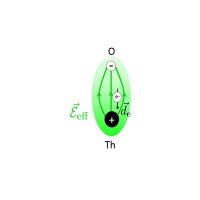
Improved Measurement of the Electron’s Electric Dipole Moment

Although the Standard Model of particle physics, one of the triumphs of modern physics, accurately describes all particle physics measurements made in laboratories so far, it is unable to answer many questions that arise from cosmological observations, such as the long-standing puzzle of why matter dominates over antimatter throughout the observable universe. To explain these...

Read More »

Tue, September 25, 2018

Honing quantum sensing

PhD student David Layden in the Quantum Engineering Group has a new approach to spatial noise filtering that boosts development of ultra-sensitive quantum sensors. New research from MIT’s interdisciplinary Quantum Engineering Group (QEG) is addressing one of the fundamental challenges facing these quantum sensor systems: removing environmental noise from the signal being measured. “The usual...

Read More »

Sat, September 1, 2018

Laser-cooling and Optical Trapping of Diatomic Molecules

Ultracold molecules have been proposed as a rich resource for many applications ranging from precision measurements and quantum metrology to quantum simulation and quantum information processing. The benefits of molecules in all these applications arise from the many internal degrees of freedom in a molecule. For example, even with the simplest two-atom diatomic molecules, one...

Read More »

Thu, June 14, 2018

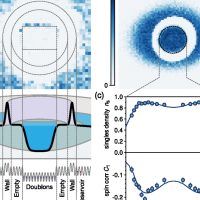
Quantum state engineering of a Hubbard system with ultracold fermions

Accessing new regimes in quantum simulation requires the development of new techniques for quantum state preparation. We demonstrate the quantum state engineering of a strongly correlated many-body state of the two-component repulsive Fermi-Hubbard model on a square lattice. Our scheme makes use of an ultralow entropy doublon band insulator created through entropy redistribution. After isolating...

Read More »