Analog quantum simulators use the continuous evolution of a controlled quantum system to explore quantum phenomena that can be difficult to calculate on an classical computer. But the delicate quantum information that makes them useful is vulnerable to noise. Protecting that information while preserving its desired evolution is a central challenge.
In a theoretical study, Elovenkova, Hu, and Yelin develop quantum error-correcting codes designed to accomplish these goals. Their research preprint provides explicit mathematical constructions of quantum error correcting codes that preserve continuous quantum transformations while allowing information to be recovered with a small error after losses at known locations.
Quantum error correction spreads a logical quantum state across a larger collection of physical systems. For analog computation, however, a fundamental obstacle arises: the Eastin–Knill theorem rules out finite-dimensional codes that both correct local errors perfectly and support nontrivial continuous logical transformations through operations applied separately to the quantum subsystems.
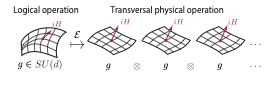
The researchers allow a controlled imperfection in recovery. Their codes remain exactly compatible with the desired continuous transformations, a property called covariance: rotating the logical state and then encoding it gives the same result as encoding first and applying the corresponding rotation to every physical component. Error correction is approximate, and becomes more accurate as the encoding grows.
The key is to limit what a small part of the system can reveal. By choosing encodings with suitable permutation symmetries, the researchers distribute logical information across the whole block. An individual quantum subsystem then carries only a weak imprint of the logical state. Losing it leaks little information to the surroundings, leaving the remaining system able to support accurate recovery. The construction extends from ordinary qubits to quantum systems with more than two levels.
The authors then connect the codes to analog dynamics. They organize symmetry-respecting evolution into mathematical blocks and encode those blocks separately, allowing the corresponding continuous operations to act directly on the encoded system. Suitable additional controls that break the symmetry can supply universal control under the paper’s stated conditions. Those extra controls require operations beyond the protected transversal set, thus defining so-called resource gates.
These theoretical results establish building blocks for protected analog quantum computation. Turning the framework into a working architecture will require practical methods for preparing the encodings, carrying out recovery, and protecting the additional controls needed for universal computation and left for the future work.