
Neutral atoms are a promising platform for quantum science, enabling advances in areas ranging from quantum simulations and computation to metrology, atomic clocks, and quantum networking. However, atom loss during operation typically limits these systems to function in a pulsed mode, preventing them from completing extended calculations. If neutral atom systems could function continuously, researchers could substantially enhance experiment cycle rates, remove bottlenecks in metrology, and enable utility-scale quantum computing through quantum error correction.
In a recent publication, the Lukin lab demonstrated a new experimental architecture that can rapidly reload lost atoms while maintaining stored quantum information, allowing for coherent continuous operation of a large-scale atom-array system. They used two optical lattice conveyor belts to transport atom reservoirs into the science region, where atoms were repeatedly extracted from the reservoir and moved into the array by optical tweezers. Achieving a reloading rate of 300,000 atoms in tweezers per second, the team created over 30,000 initialized qubits per second, which they leveraged to assemble and maintain an array of over 3,000 atoms for more than 2 hours. Furthermore, they were able to persistently refill the array with atomic qubits in either spin-polarized or coherent superposition states without changing the quantum states of stored qubits nearby.
These results pave the way for the realization of large-scale continuously operated atomic clocks, sensors, and fault-tolerant quantum computers.
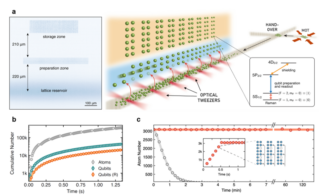
Figure 1. (a) In this system, two optical lattice conveyor belts transport a reservoir of cooled Rubidium-87 atoms into the science region. Once atoms enter the science region, a two-dimensional array of optical tweezers extracts atoms from the reservoir and moves them into the “preparation zone,” where they are laser cooled, arranged into an array, “shielded,” and initialized into a qubit state. After the atoms are prepared, they’re shuttled into the “storage zone,” where atoms are held in a larger array of optical tweezers. Left: averaged fluorescence image of atoms in our system, showcasing the three zones. (b) Cumulative number of atoms and qubits obtained in tweezers by repeated reservoir extraction cycles. The grey markers correspond to the maximum rate at which atoms can be extracted from the reservoir, which is 300,000 single atoms per second, with brief interruptions when the reservoir is being replaced. When performing the qubit preparation sequence after each extraction, one obtains a continuous flux of fresh qubits; 30,000 qubits per second without (green), and 15,000 qubits per second with rearrangement (orange). (d) Iterative construction and continuous maintenance of a large-scale atom array. Initial assembly occurs in 0.5 seconds via 6 loading iterations, filling one subsection at a time (inset). By replacing the oldest subsection every 80 ms, we demonstrate cyclic replenishment and continuous maintenance of an array of 3,000+ atoms for over 2 hours of operation, far beyond the natural tweezer-limited lifetime of about 60 seconds (grey). At the final data point of 2.3 hours over 50 million individually imaged and rearranged atoms have been cycled through the storage array.