
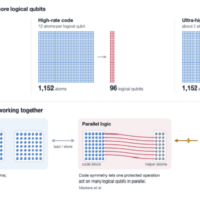
Building a useful quantum computer requires protecting fragile quantum information, but that protection can consume much of the machine’s hardware. Hengyun Zhou’s group at MIT and collaborators are developing ways to dramatically reduce that overhead. Across a series of recent studies, they have shown how to pack quantum information into efficient error-correcting codes, design more compact versions, and perform protected operations on many encoded qubits in parallel. Collaborative work within the Center for Ultracold Atoms (CUA) connects these advances with efficient preparation of the special quantum states needed for universal computation.
In an April study led by Chen Zhao, Zhou’s group and collaborators helped bridge ultra-high-rate error-correcting codes and physical implementation. Building on an existing mathematical construction, the team co-designed the codes and their implementation for reconfigurable neutral-atom arrays—a platform pioneered by researchers within the CUA. These codes encode more than one logical qubit, the protected unit of quantum information, for every two physical data qubits. By sharing protection across hundreds of logical qubits, they use redundancy remarkably efficiently. Computer simulations showed extremely low error rates even when errors in the protection circuits were included.
Zhou’s group then worked with collaborators to make these codes more compact and their design more systematic. The researchers developed principles for balancing how much quantum information a code stores, how strongly it protects that information, and how complicated its error checks must be. Guided by these principles, they introduced new code families that provide strong protection in blocks of only hundreds of physical qubits. These smaller building blocks could bring efficient quantum error correction within reach of more modest machines, while giving designers a clearer way to choose codes suited to their hardware.
Efficient storage is only part of the challenge; a quantum computer must also manipulate the information it protects. In a study led by Nishad Maskara, Zhou’s group collaborated with Mikhail Lukin’s group at Harvard, another member of CUA, to develop fast, parallel operations for ultra-high-rate codes. By exploiting patterns and symmetries in the codes, they showed that many operations can share the resources needed to protect them from errors. The team also developed methods for transferring special “magic states” into computation. Together, these techniques help extend the benefits of high-rate codes from quantum memory to quantum processing.
This line of work is complemented by a collaboration with Lukin’s group that tackles the production of those magic states, which supply the additional ingredient needed for universal quantum computation. The researchers combined codes with three-dimensional mathematical structure that generate these states efficiently with codes that protect them after preparation. Simulations showed substantial reductions in the combined hardware and time costs of magic-state production. Together, these studies point toward an architecture in which compact storage, parallel processing, and efficient magic-state preparation work hand in hand, illustrating how collaboration across the CUA can advance the path toward useful quantum computers.
Caption: Doing more with the same quantum hardware. (a) Each column draws the same 1,152 atoms (blue) used as data qubits and, at the same scale, the protected logical qubits (red) that one type of error-correcting code stores in them. All three codes have distance 12, a measure of how many errors they can withstand; for the ultra-high-rate code, 12 is an upper bound. Every scheme also needs additional atoms for error checks, and the comparison does not imply identical error rates. (b) Schematic of how the four studies fit together. Compact code blocks store logical qubits, code symmetry lets one protected operation act on many logical qubits in parallel, and a factory built from codes with three-dimensional structure supplies magic states.
Credit: Illustration prepared for this highlight. Code parameters in (a): surface code with 144 data qubits per logical qubit; [[144, 12, 12]] bivariate bicycle code (Bravyi et al., Nature 2024); [[1152, 580, ≤12]] code (Zhao et al., arXiv:2604.16209).
Further reading
Chen Zhao et al., Towards Ultra-High-Rate Quantum Error Correction with Reconfigurable Atom Arrays (April 2026; revised June 2026).
Jong Yeon Lee et al., Design Principles for Ultra-High-Rate Quantum Codes (September 2026).
Nishad Maskara et al., Efficient Logic with Ultra-High-Rate Quantum Codes (October 2026).
Varun Menon et al., Single-shot magic state factories for quantum LDPC codes (October 2026).