
Quantum low-density parity-check (qLDPC) codes promise to protect quantum information with far fewer physical qubits than the surface code. Realizing this promise requires a classical decoder that interprets error syndromes both accurately and in real time, and no existing decoder does both. In this work, we introduce Cascade, a convolutional neural network decoder built around the regular geometry of these codes. Because every stabilizer has the same local connectivity, the network applies one set of learned rules at every site, resolving small error patterns first and larger ones in later layers.
In simulations of the [[144,12,12]] Gross code at a physical error rate of 0.1%, Cascade reaches logical error rates near 10−10, about 17 times below the Relay decoder. Its accuracy is comparable to far slower decoders, at several orders of magnitude higher throughput, and a single GPU keeps pace with trapped-ion and neutral-atom cycle times. This accuracy also reveals a ‘waterfall’ in error suppression. Resource estimates usually assume that a code fails through its smallest uncorrectable errors, which are set by the code distance, but these errors are so few that they rarely occur. A strong decoder instead fails mainly on much larger error patterns, whose rate falls steeply as hardware improves, so logical error rates drop far faster than distance predicts.
These results suggest that a target logical error rate can be reached with a smaller code. On the surface code, Cascade reaches 10−9 with about 40% fewer physical qubits than minimum-weight perfect matching. Its calibrated confidence estimates can also reduce the time overhead of repeat-until-success protocols. Together, these effects point to lower space-time costs for fault-tolerant quantum computation than previously anticipated.
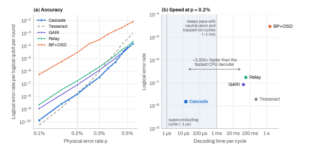
Accuracy and speed on the Gross code. The logical error rate measures how often encoded information fails. (a) This rate per logical qubit per round against physical error rate p for the [[144,12,12]] code under circuit-level depolarizing noise. (b) Logical error rate against decoding time per cycle at a physical error rate of 0.2%. Cascade’s time is the batched throughput of one NVIDIA H200 GPU. Cascade matches the accuracy of Tesseract, the most accurate decoder, and is about 3,000 times faster than the fastest CPU decoder. The shaded region marks decoders that keep pace with neutral-atom and trapped-ion cycles. The steepening of the Cascade curve in (a) at moderate p is the waterfall regime.