
What governs the laws of the most fundamental particles? Why is the universe made of matter, not antimatter? The Fan group is developing an experiment with radioactive thorium monofluoride molecular ions, ²²⁹ThF⁺, to search for new fundamental interactions that could lead to the discovery of new particles and help explain this. Our sensor is the asymmetricity of the nucleus—the so-called nuclear Schiff moment—that would signal violations of fundamental symmetries. The nuclear structure of ²²⁹Th strongly enhances this effect, and by combining it with molecular quantum precision spectroscopy, we will establish a route to probe new physics involving quarks and gluons.
The Fan group started in July 2025. The apparatus pictured here, photographed in October 2026, is being developed to produce, cool, and interrogate these rare radioactive molecules. The team has demonstrated extraction of ²²⁹Th ions from a ²³³U source, controlled molecular-ion formation, transport and accumulation, and trapped atomic thorium-ion spectroscopy. Building on these advances, the researchers are developing cryogenic cooling and optical and microwave methods to coherently manipulate ²²⁹ThF⁺’s quantum states. The long interrogation times, combined with the nuclear enhancement and molecular fields, will lay the groundwork for fundamental physics tests and extend the tools of ultracold atomic and molecular physics to sensitive new-particle searches.
← Back to News 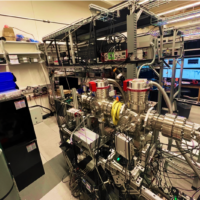
News
Mon, November 2, 2026
Quantum Precision Measurement for Fundamental Physics
News type: Research Highlights