
Skip to content
← Back to All News

News: Research Highlights

262 articles

Sun, November 20, 2022

Quantum sensor can detect arbitrary frequency electromagnetic signals

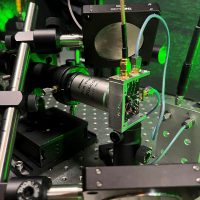
Quantum sensing is essential in tasks ranging from characterization of quantum devices, to exploration of magnetism in condensed matter, to imaging of microwave structures. Current quantum sensors have achieved excellent performance combining high sensitivity with spatial resolution. However, the frequency range of the signal fields that can be measured is still limited to either a...

Read More »

Sun, November 20, 2022

Photonic Circuits to Program Atoms at Scale

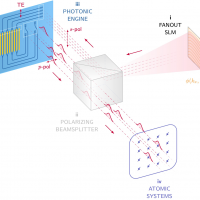
How do we control large numbers of qubits? This is a question being asked across quantum information science, including for atomic qubits. Unlike other varieties of qubits—such as superconducting qubits, where control signals are primarily electrical—atomic qubits are controlled by beams of light. Individual control over each atomic qubit requires modulating many individual optical beams....

Read More »

Sun, November 20, 2022

Brain-inspired quantum machine learning for decision-making, entanglement witnessing, time-reversal

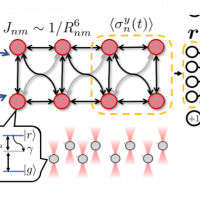
Quantum computing promises to enhance machine learning algorithms. However, implementing these advantages often relies on either fault-tolerant quantum computers not yet available, or on decoherence-limited, variational quantum circuits which may experience training bottlenecks. Thus, currently available noisy intermediate-scale quantum (NISQ) devices thwart quantum advantages in machine learning algorithms. Recently, quantum machine learning architectures have emerged...

Read More »

Mon, November 14, 2022

Benchmarking quantum devices based on fingerprints of quantum chaos

We have developed a new method to quantify the performance of analog quantum simulators, using insights from quantum chaos.  The state fidelity quantifies the closeness of two quantum states. While theoretically simple, the fidelity is difficult to measure in experiments since most conventional approaches require sophisticated controls not accessible in existing devices. CUA researchers and...

Read More »

Mon, November 14, 2022

Quantum Mechanics Intertwines Symmetries: how to study deconfined quantum criticality using analog quantum simulators

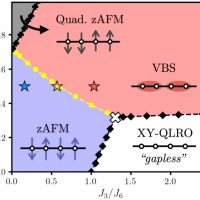
With rapid advances in our experimental capability to perform quantum simulations, it is also important to ask what interesting physical phenomena we would like to explore. One interesting direction is the realization of deconfined quantum criticality (DQC), a concept central to the modern understanding of various quantum phase transitions yet experimentally unobserved phenomena. In conventional...

Read More »

Thu, November 10, 2022

First demonstration of scaling speedup in solving an optimization problem on a programmable quantum simulator

An international collaboration of physicists and computer scientists led by the Harvard-MIT CUA Professors Lukin, Greiner, and Vuletic demonstrated an important milestone in the broad effort to realize practical quantum advantage. The researchers used a programmable Rydberg atom array quantum simulator with up to 289 qubits to solve classically hard combinatorial optimization problems. They used...

Read More »

Mon, June 6, 2022

Researchers document presence of quantum spin liquids, an elusive state of matter never seen before

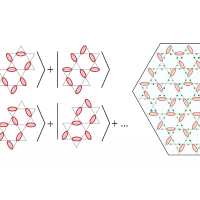
The Harvard-MIT CUA collaboration led by Lukin, Greiner, and Vuletic reported the first experimental realization of a quantum spin liquid, a highly entangled phase of matter that eluded experimental observation for several decades.  An example of topological state, such as a spin liquid, can help in the search for reliable quantum computers. Predicted about 50...

Read More »

Wed, March 9, 2022

Physicists steer chemical reactions by magnetic fields and quantum interference

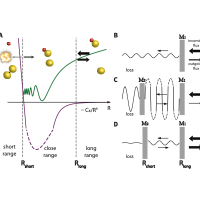
Physicists in the MIT-Harvard Center for Ultracold Atoms (CUA) have developed a new approach to control the outcome of chemical reactions. This is traditionally done using temperature and chemical catalysts, or more recently with external fields (electric or magnetic fields, or laser beams). MIT CUA physicists have now added a new twist to this: They...

Read More »

Thu, February 3, 2022

Reversing time for quantum-enhanced metrology

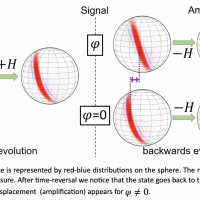
The group of Prof. Vuletic, at MIT, demonstrated that reversing the time in an atomic sensor can lead to a strongly enhanced sensitivity. With this time-reversal protocol, sensors can be operated with highly-entangled states which carry large statistical information close to the fundamental Heisenberg Limit.  Due to their fragility, these “superior” quantum states are extremely...

Read More »

Thu, February 3, 2022

Searching for dark matter by probing an ultranarrow optical transition in Ytterbium

The Vuletic ion lab at MIT has been searching for new dark matter candidates by measuring small shifts between atomic transition frequencies in different isotopes of Ytterbium. Measuring shifts on at least two transitions allows the researchers to plot the data in a “King Plot”, which can reveal the presence of both higher-order nuclear physics...

Read More »