
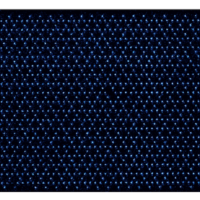
Arrays of individual atoms, each held in place by a tightly focused laser beam called an optical tweezer, have become a leading platform for quantum computing, quantum simulation, and precision measurement. One of the most powerful features of this platform is that each atom can be moved independently of the others, for example to arrange atoms into specific geometries or to shuttle them between different regions during a quantum circuit. However, as state-of-the-art arrays grow to thousands of atoms, rapid atom transport becomes challenging, since existing techniques typically move a subset of atoms only along rows and columns.
Now, the Ni and Yao groups at Harvard have demonstrated a new technique for transporting every atom in a large-scale array simultaneously in arbitrary directions. The team used a spatial light modulator, a screen of liquid-crystal pixels that displays a hologram, to shape a single laser beam into a tweezer array. By displaying a rapid sequence of holograms, each shifting the tweezers by a small step, they moved all of the atoms at once, each along its own path. The researchers found that the atoms remained trapped even when the holograms changed faster than the liquid crystal could fully respond, which sped up the transport process. Using this approach, they assembled a nearly perfect array of more than 2000 ytterbium atoms, the largest rearranged ytterbium array to date, and even moved atoms between stacked layers in three dimensions.
The technique requires no specialized hardware beyond a spatial light modulator, a device already common in atom-array labs, making it straightforward to implement for other research groups. More broadly, the ability to move atoms freely in three dimensions opens new possibilities for how atoms are arranged and controlled in future quantum technologies
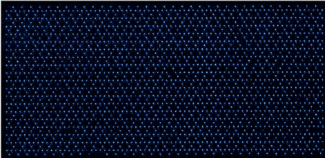
Image caption: A single-shot image of an optical tweezer array with more than 2000 ytterbium atoms arranged into a kagome lattice.